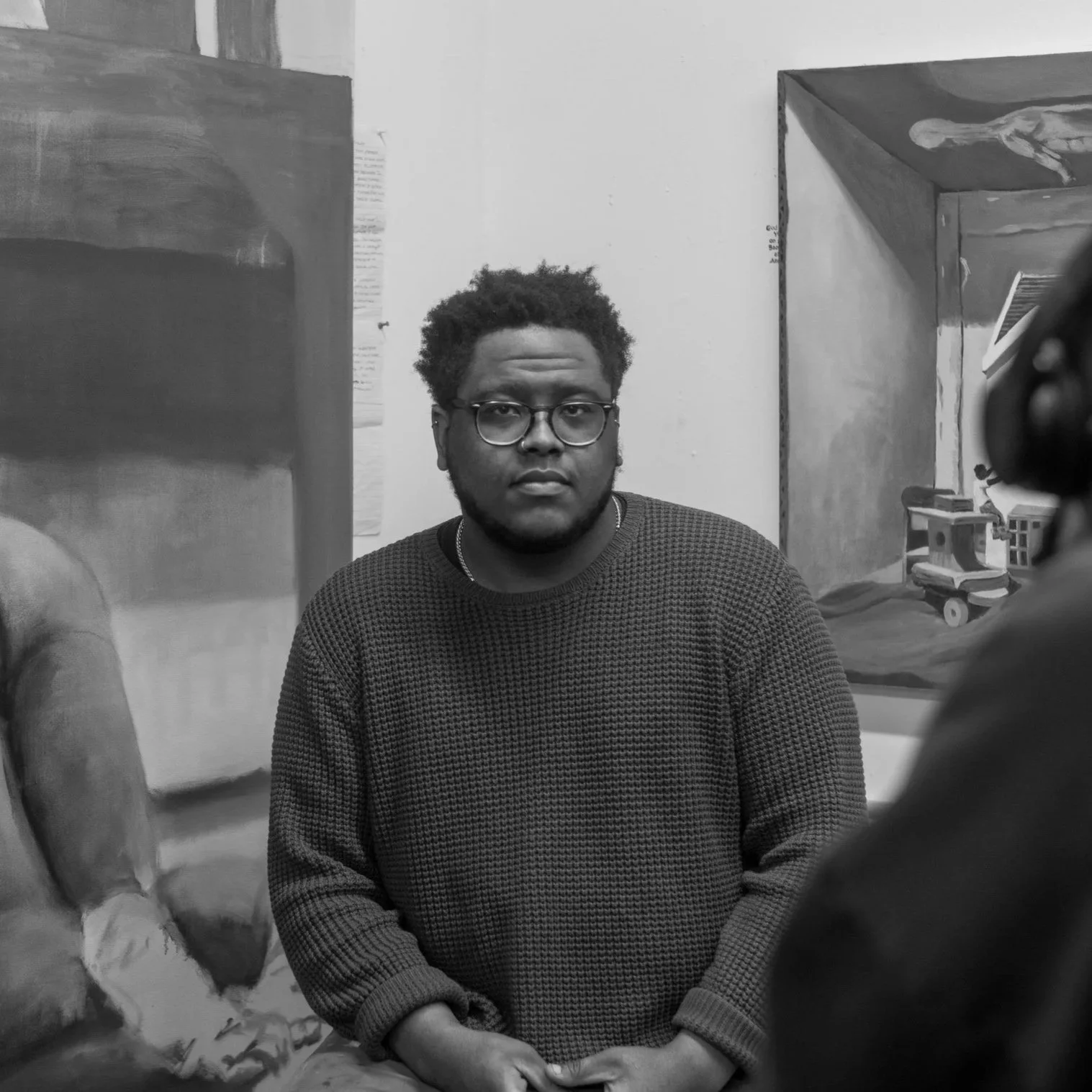
Isaiah Lee’s paintings construct fragmented worlds where memory, belief, and evolution converge. Working through a Black surrealist lens, Lee reimagines folklore through religious iconography, visual distortion, and dream logic, developing a recurring universe of figures and environments that give form to Black interior life. Informed by a fundamentalist upbringing in Missouri, his work examines how belief systems shape belonging, survival, and identity. Drawing on lived and witnessed experiences—particularly the anxiety of intimacy and cycles of addiction and shame—Lee uses surrealism to excavate psychological and spiritual states. Giants, ghosts, and sentries appear as both protective and ominous presences, while objects take on anthropomorphic roles. Through saturated color, heightened scale, and theatrical composition, Lee stages spaces that feel both romantic and unsettling, positioning the viewer between observer and participant. His paintings function as sites of recognition and inquiry, engaging psychological depth and spiritual complexity within the Black surrealist imagination.